
5-star - Long-durational Performance
Part of group exhibition "Fluid Persistence"
Curated by Elena Stylianou
Nicosia Municipal Arts Centre (NiMAC) / Nicosia - CY
Decemeber - 2025 / Duration: 120'
"5-star (Drone Version)", Video, PASHIAS, 2025, 60''
5-star: Curatorial Note
By Elena Stylianou
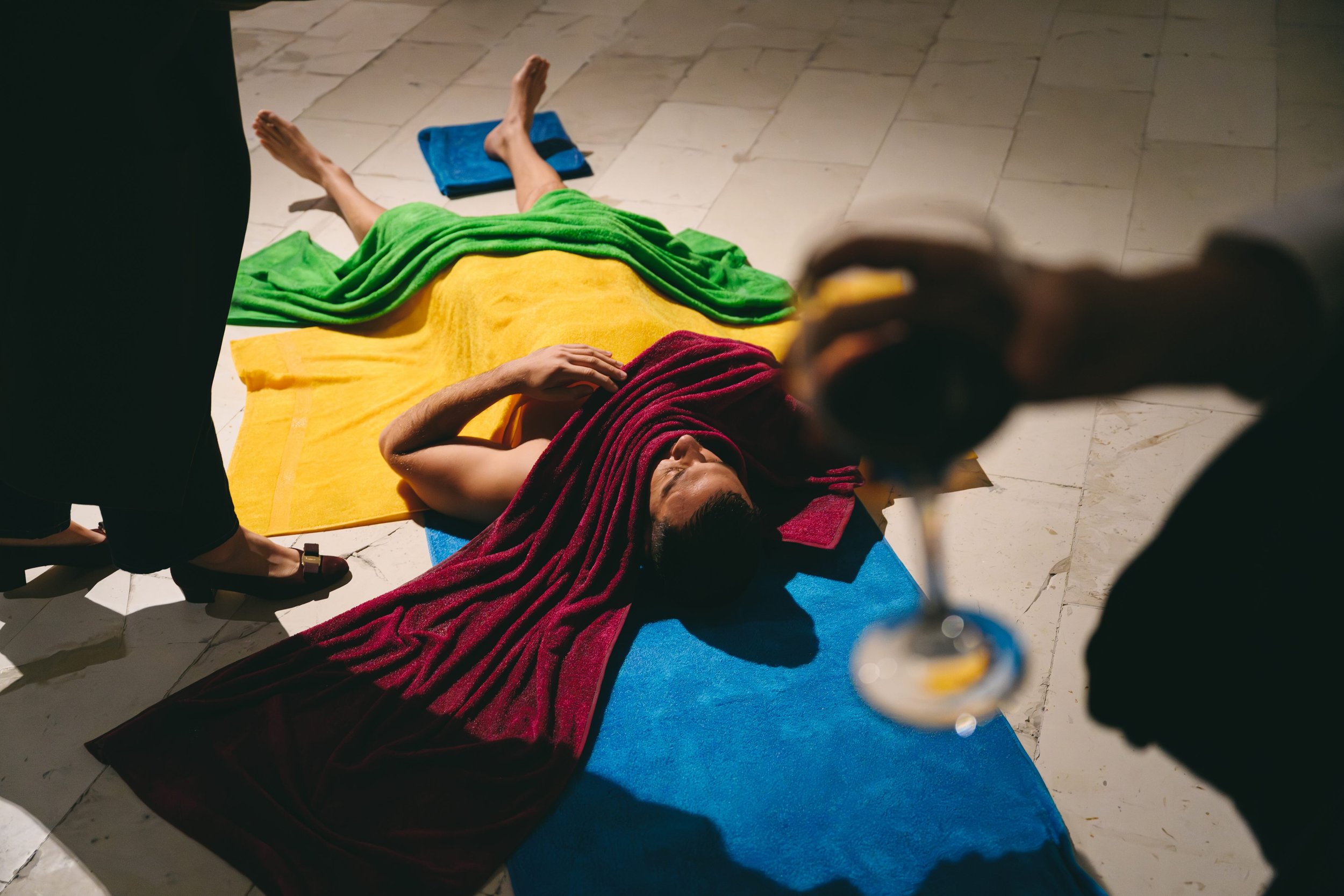
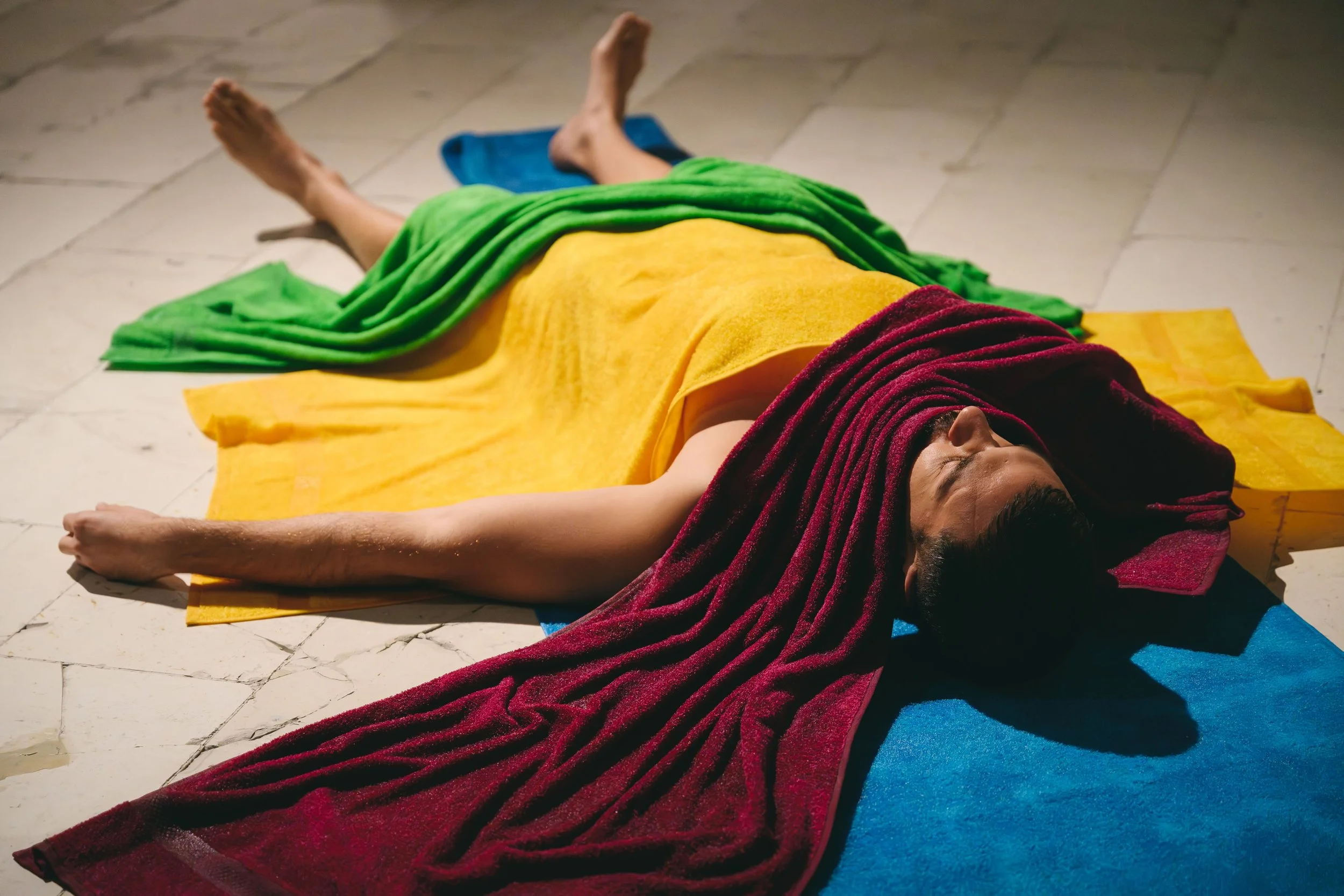
This work evolves from the artist’s earlier exploration of vessels as containers of water, memory, and experience, replacing the vessel with the human body itself. At the heart of the work is a long-duration, immobile performance - a living stillness that draws attention to contrasts such as vitality and lifelessness. Towels evoke leisure, relaxation, and tourism, but their bright, kitsch colours also point to the harsh realities of luxury tourism and luxury economies. They reference the ways hotel owners and tourist infrastructures reshape coastlines, suffocate beaches, and privatize sand, masking the environment beneath commercial spectacle.
The performance was recorded using a drone, introducing an aerial, distanced point of view that mirrors the visual language of contemporary tourist culture. This elevated gaze recalls promotional imagery and social media aesthetics that transform landscapes and bodies into consumable surfaces. At the same time, the drone’s hovering presence invokes modes of surveillance increasingly applied to the sea and the human body alike - monitoring borders, tracking movement, and asserting control over spaces once associated with freedom and openness.
Through this interplay of the body, the fabric, and the film frame, the work becomes a critique: the tactile, folded forms recall those human gestures that suffocate and intervene, while also revealing how personal and collective experiences are constrained by contrasting financial and ecological pressure.
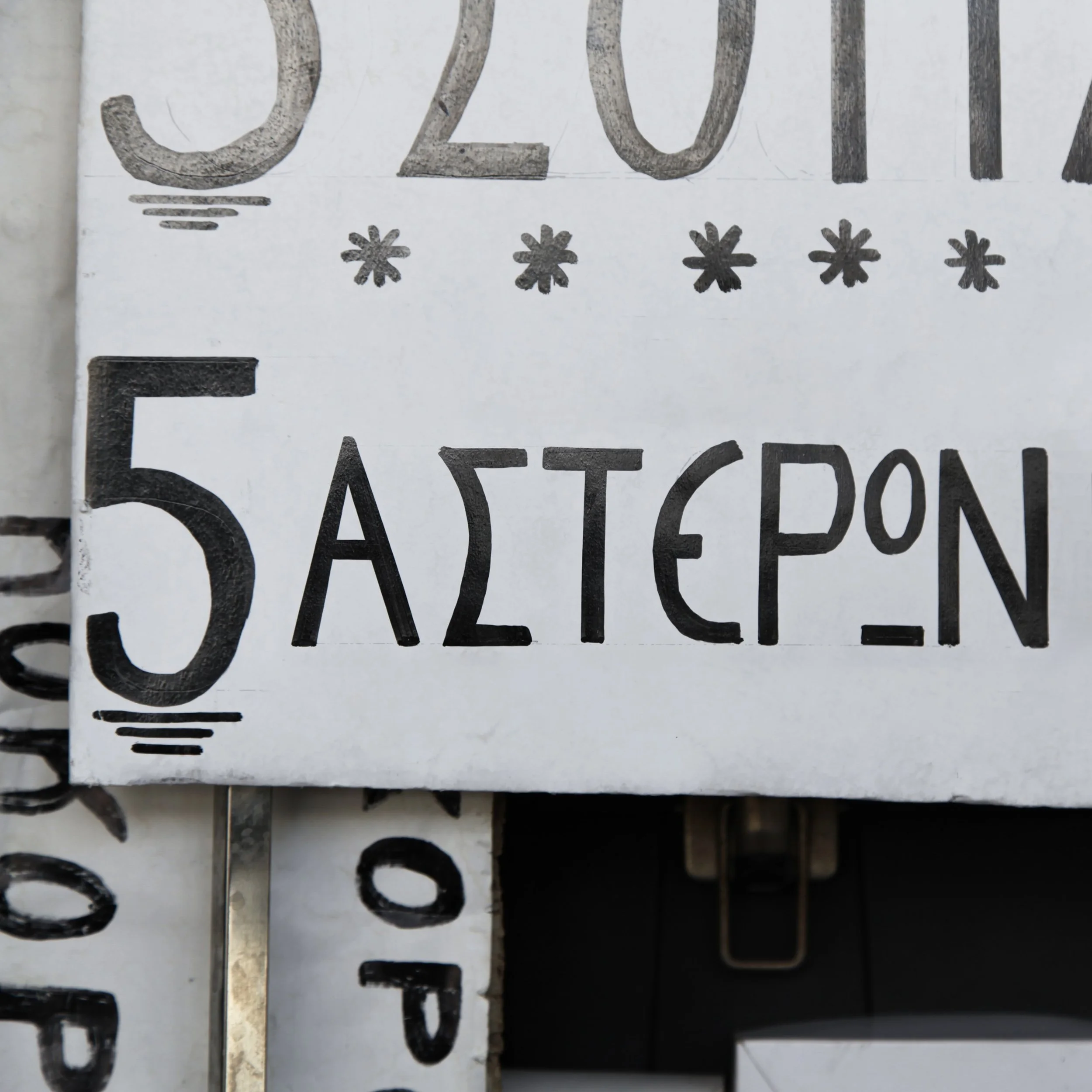
Promo Photo: PASHIAS, 2025
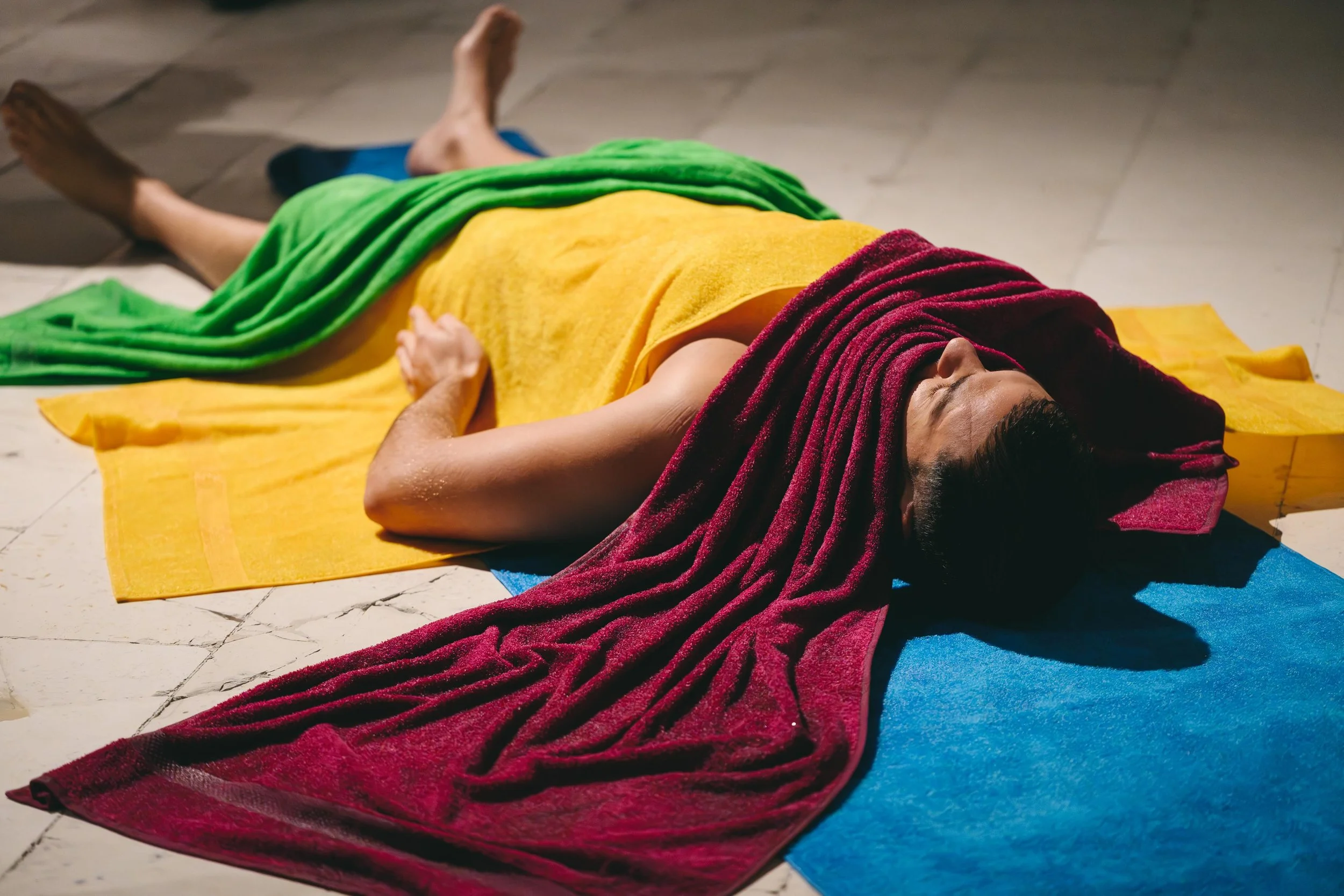
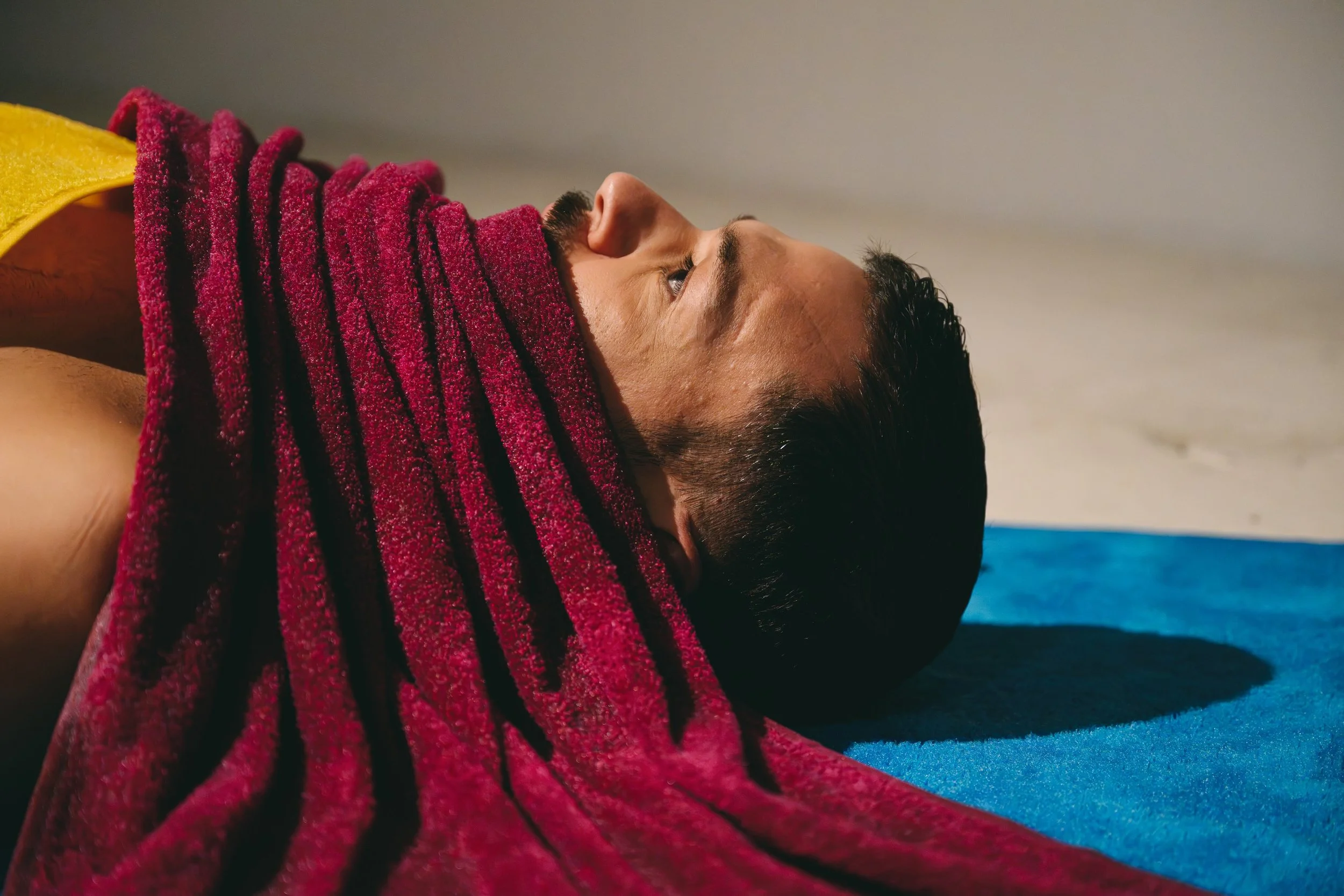
Photography: Pavlos Vrionides
Drone: Eftychios Shikkis
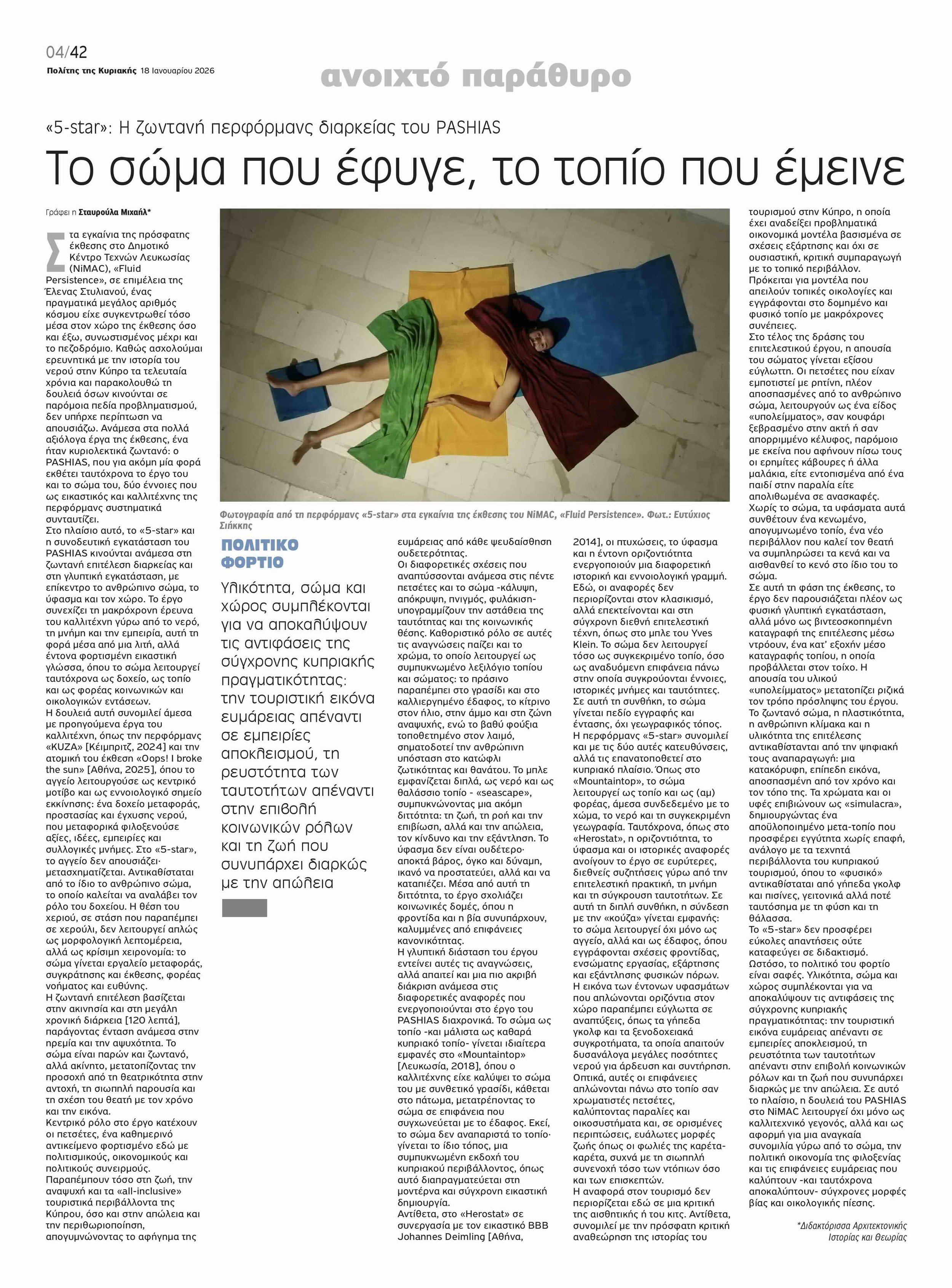
The body that left, the landscape that remains - PASHIAS' long-durational performance "5-star": Article by historian Stavroula Michael
"Parathyro" for Politis Newspapert, 19/01/26 - Read Article (GR)
At the recent opening of group exhibition "Fluid Persistence" at the Nicosia Municipal Arts Centre (NiMAC), curated by Elena Stylianou, a truly large crowd gathered both inside and outside the museum, crowding even the sidewalk. As I have been researching the history of water in Cyprus for a number of years, following the work of those involved in similar fields of inquiry, there was no way I could miss it. Among the many remarkable works in the exhibition, one was literally alive: PASHIAS, who once again exhibits both his work and his body - two concepts that, as a visual artist and performance artist, he systematically equates.
In this context, "5-star" and the accompanying installation by PASHIAS, move between live performance and sculptural installation, focusing on the human body, fabric, and space. The work continues the artist's long-standing research on water, memory, and experience, this time through a simple, yet highly charged visual language, where the body functions simultaneously as a vessel, a landscape, and a carrier of social and ecological tensions.
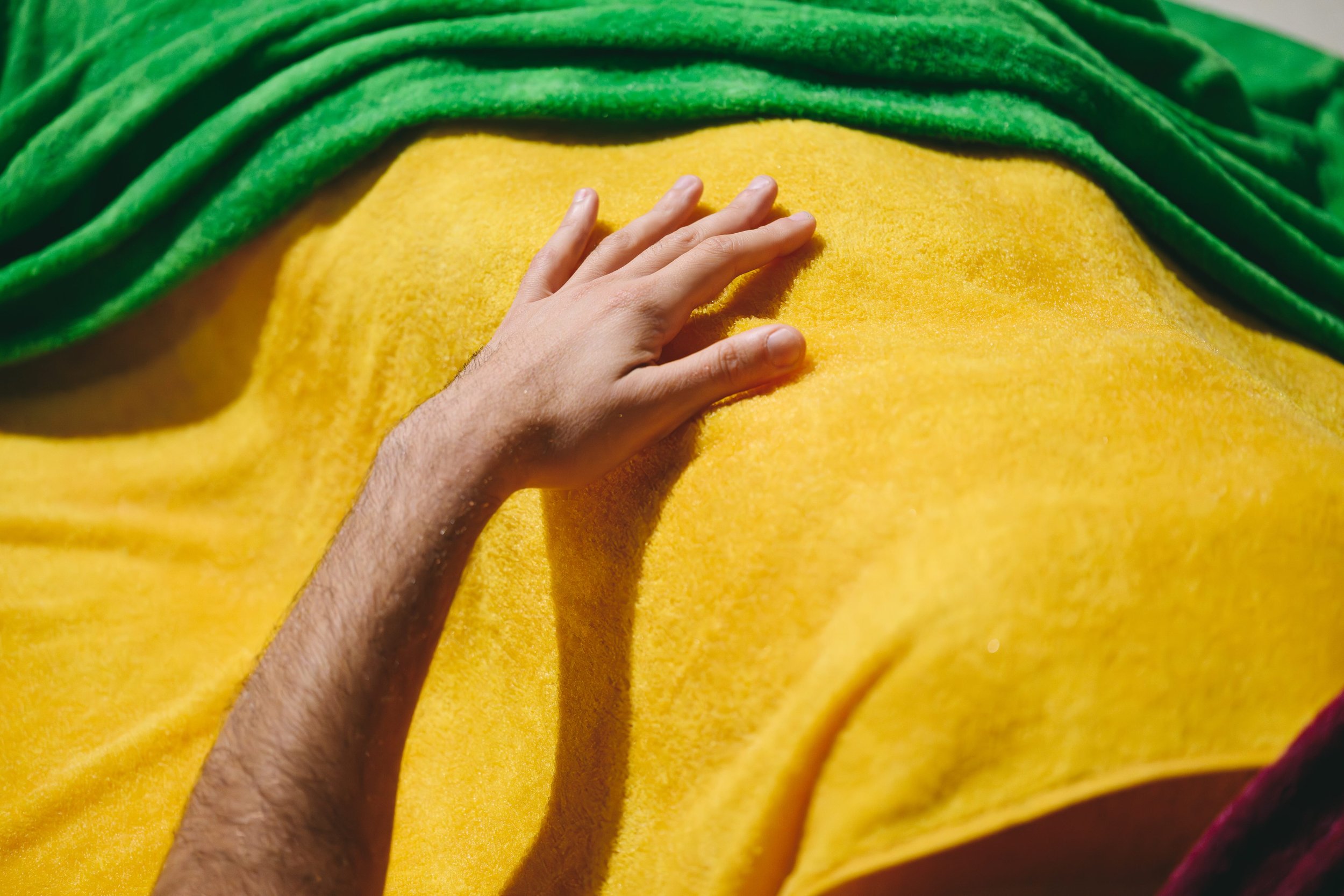
"5-star" is in direct dialogue with the artist's previous works, such as the performance "KUZA" (Cambridge, 2024) and his solo exhibition "Oops! I broke the sun" (Athens, 2025), where the amphora served as a central motif and ideological starting point: a vessel for transporting, safekeeping, and spilling water, which metaphorically contained values, notions, experiences, and collective memories. In "5-star", the vessel is not absent; it is transformed. It is replaced by the human body itself, which is called upon to take the role of the container. The position of the arm - hand, in a posture reminiscent of a handle, does not function merely as a morphological detail, but as a critical gesture: the body becomes a tool for transport, retention, and exposure, a carrier of meaning and responsibility.
The live performance is rooted in immobility and in its lengthy duration (120 minutes), producing tension between calmness and lifelessness. The body is present and alive, yet motionless, shifting attention from theatricality to endurance, silent presence, and the viewer's own relationship with time and image.
Towels play a central role in the work, everyday objects charged here with cultural, economic, and political connotations. They allude both to life, leisure, and the 'all-inclusive' tourist environments of Cyprus, as well as to loss and marginalization, stripping the narrative of prosperity from any illusion of neutrality.
The diverse relationships that develop between the five towels and the body - covering, concealing, suffocating, imprisoning - emphasize the instability of identity and social status. Color also plays a decisive role in these readings, functioning as a condensed vocabulary of landscape and body: green evokes grass and cultivated earth, yellow recalls the sun, sand, and the leisure zone, while the deep fuchsia, placed around the neck, signifies human existence on the threshold between life and death. Blue appears twice, as water and as seascape, condensing yet another duality: life, flow, and survival, on the one hand, loss, danger and exhaustion, on the other. The fabric is not neutral; it acquires weight, volume, and power, capable of protecting, but also suppressing. Through this duality, the work comments on social structures, where care and violence coexist, covered by layers of normality.
The work’s sculptural dimension reinforces these readings, but also requires a more precise distinction between the diverse references that are activated in PASHIAS' work over time. The body as landscape - and indeed as a distinctly Cypriot landscape - becomes particularly evident in "Mountaintop" (Nicosia, 2018), where the artist covered his body in synthetic grass, sitting on the floor, transforming his body into a surface that merges with the ground. There, the body does not represent landscape; it becomes the 'place' itself, a condensed version of the Cypriot environment, as negotiated in modern and contemporary visual art.
In contrast, in "Herostrat", PASHIAS' collaboration with visual artist BBB Johannes Deimling (Athens, 2014), the fabric drapery and the pronounced horizontality, activate a different historical and conceptual trajectory. Here, the references are not limited to classicism, but extend to the international scene of contemporary performance art, as in the use of Yves Klein's blue. The body functions less as a specific landscape, and more as an emerging surface on which notions, historical memories, and identities collide. In this context, the body becomes a field of inscription and tension, instead of a geographical place.
The performance "5-star" engages with both of these directions, but re-situates them within the Cypriot context. As in "Mountaintop", the body functions as a landscape and a vehicle, directly connected to the soil, the water, and the specific geography. At the same time, as in "Herostat", horizontality, fabric, and historical references open the work up to broader, international discussions around performance practices, memory, and the clash of identities. In this dual condition, the connection with the 'kuza (amphora)' becomes apparent: the body functions not only as a vessel, but also as a terrain, inscribed with relationships of care, bodily labor, of dependence, and the depletion of natural resources.
The image of brightly colored fabrics spread horizontally across space is an eloquent nod to developments, such as golf courses and hotel complexes, which require disproportionately large amounts of water for irrigation and maintenance. Visually, these surfaces spread across the landscape like colorful towels, covering beaches, ecosystems, and, in some cases, vulnerable life forms such as the caretta caretta turtle nests, often under the silent complicity of both locals and visitors.
Here, the discussion of tourism is not limited to a critique of aesthetics or the kitsch. Rather, it engages with the recent critical re-examination of the history of tourism in Cyprus, highlighting problematic economic models based on relationships of dependency, rather than meaningful, critical co-production with the local environment. These are models that threaten local ecologies and are inscribed in the built and natural landscape with long-term consequences.
At the end of the performance's action, the absence of the body becomes equally eloquent. The towels that had been soaked in resin, now detached from the human body, function as a kind of 'remnant', like a carcass washed up on the shore or a discarded shell, similar to those left behind by hermit crabs or other crustaceans, either found by a child on the beach or by excavations in their fossilized form. Without the body, these fabrics compose an emptied, stripped-down landscape, a new environment that invites the viewer to fill in the voids and feel the void in their own body.
At this phase of the group exhibition, the work is no longer present as a tangible sculptural installation, but only as a video recording of the performance via drone - a quintessential instrument for landscape documentation - projected on the wall. The absence of the material 'remnant' radically shifts the way the work is perceived. The living body, the plasticity, the human scale, and the materiality of the performance are replaced by their digital reproduction: a vertical, flat, moving image, detached from its time and place. Colors and textures survive as simulacra, creating a dematerialized meta-landscape that offers proximity without contact - corresponding to the artificial environments of Cypriot tourism, where the 'natural' is replaced by golf courses and swimming pools, neighboring yet never identical to nature and the sea.
"5-star" does not provide us with easy answers, nor does it resort to didacticism. However, its political significance is clear. Materiality, body, and space intertwine to reveal the contradictions of contemporary Cypriot reality: the tourist image of prosperity versus experiences of exclusion, the fluidity of identities versus the imposition of social roles, and life that constantly coexists with loss. In this context, PASHIAS' work at NiMAC functions not only as an artistic happening, but also as the occasion for a necessary conversation around the body, the political economy of hospitality, and the surfaces of prosperity that cover - and at the same time reveal - contemporary forms of violence and ecological pressure.